On the buses: Exploring public transport barriers for older people
Public transport often plays a crucial role in supporting older people’s independence and wellbeing, helping people to get out and about and do the things that matter to them.
Yet older people across Wales frequently raise issues relating to public transport with me and my team, describing a range of challenges and barriers that make getting from A to B more difficult, if not impossible.
To get a better understanding of the issues older people often face, my team and I have been undertaking a series of journeys via public transport in different parts of Wales, recreating the kinds of journeys older people can be required to make – to attend medical appointments, for example, access local authority services, or manage their finances.
These journeys have also provided opportunities for informal conversations with older passengers to learn more about their experiences of using public transport and any challenges they have faced.
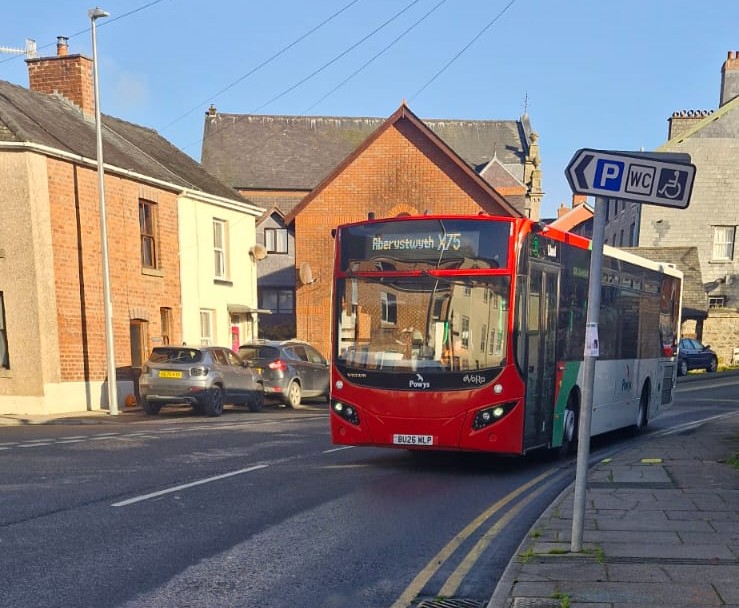
I wanted to share my reflections, having begun the week travelling from Llanidloes in Powys to Aberystwyth in Ceredigion, recreating a journey recently made by an older person who had to attend an appointment at Bronglais Hospital.
While the journey itself was relatively straightforward – just over an hour by bus with no changes – the frequency of services is limited, running only every two hours. This means that if you have an appointment at 12.30pm, you’d need to get the 9.45am bus (arriving just before 11am) to arrive on time. Similarly, assuming your appointment took around an hour, you’d then have to wait until 3.30pm for a bus home.
Before my journey began, I had to navigate narrow pavements or walk along sections of road with no pavements at all, something which older people have highlighted as a particular barrier to using public transport.
I was also slightly puzzled when I arrived at the location of the bus stop only to find there were no signs of a bus stop. Thankfully, some helpful locals confirmed that the street corner I was on was the right place despite there being no bus stop sign or timetable. There was also no seating or shelter, so I was glad to be making my journey in fine weather.
There were no announcements on the bus, or visual signs telling you which stop was next, so it wasn’t clear which stop in Aberystwyth I needed for the hospital. This meant I needed to ask another passenger for assistance. As a bus driver himself, he was happy to help, although I may have struggled to find the right place to get off had he not been nearby.
From the bus stop (again unmarked with no signage), I had a short walk to the hospital itself. While this walk was not an issue for me, it was up a hill and could be more challenging for an older person or someone with mobility issues. This was reflected in a conversation I had with an older lady who told me she wouldn’t have been able to walk that way and instead would have to travel all the way to the bus station so she could change to a bus that would bring her closer.
The bus stop for my return journey was easier to find, with a sign and timetable (although unhelpfully the service I was using wasn’t listed), but again there was no seating or shelter.
After an hour or so on the bus, with many of the same passengers who had been on the outward journey, I was back in Llanidloes.
So what are my overall reflections on these journeys?
Well, in terms of the buses themselves, these arrived on time, were clean and appeared to be accessible (there were passengers on the bus with walking aids and trolleys). However, many older people have spoken to me about delays and cancellations, which can have big implications in terms of missed appointments and connections, particularly in areas where services are infrequent.
I was also struck by the kindness of the bus drivers on both journeys. Going out, the driver helped a lady with a visual impairment, notifying her when her stop was approaching, while the driver on the return journey went over and above to ensure an older lady I had been speaking with could get off the bus safely with her shopping bags.
But throughout the day, I was anxiously watching the clock, knowing that if I missed my planned bus back, I’d have a two-hour wait until the next one. It’s difficult to imagine how this might feel to an older person who might be attending an appointment, the stress and anxiety this might cause. What if the appointment is running late? Will you get to the bus stop in time? If not, when is the next bus?
It was also frustrating that basic things, such as clear signage, timetables, seating and shelter were often missing, which created difficulties and meant I needed to ask others for help. And while the pavements near the bus stops I used were generally in good repair, two older people shared concerns with me – one older gentleman who was nervous on pavements due to falling and breaking his arm earlier this year, and an older lady with a visual impairment who was particularly worried about the risk of falling.
Conversations like these with older passengers provided helpful insights into their experiences. One older woman told me that the bus was really important to her as she goes into Aberystwyth twice a week to do her shopping. She told me she must plan what she needs to buy and which shops to go to as she is unable to carry as much home now. This not only includes spreading out heavy purchases through the week so her shopping trolley isn’t too heavy to pull but planning for the year – buying heavy tins and jars throughout the summer so she was stocked up for the winter.
She also spoke with me about how she had previously run the shop in her village, which had become more of a ‘hub’, especially for the older people in the village who would come in for a chat and a catch up. She felt that older people had lost this ‘connection’ when the shop closed, which had increased isolation.
As I travelled through the countryside, I couldn’t help but notice how rural and relatively isolated some of the stops along the route were, how much of a lifeline these services must be for people who live in these communities. This is reflected in conversations I have with older people across Wales, which highlight the critical role public transport often plays in enabling people to do the things that matter to them and supporting them to live and age well.
That’s why the journeys my team and I are undertaking are important – so we can more clearly understand the barriers older people are facing that prevent them from accessing public transport, as well as the ways these affect people’s independence and well-being. This evidence will be crucial to inform my own work, including my upcoming report on older people’s experiences of living in rural areas, as well as the calls for change and improvements I make as Commissioner, which as always will have older people’s voices and experiences at their heart.