

Older private renters – a forgotten part of generation rent
It’s well accepted that Wales is currently experiencing a housing emergency. An emergency that sees more than 10,000 people homeless and trapped in temporary accommodation, more than 170,000 (including almost 16,000 over 55’s) stuck on waiting lists for a social home and hundreds of thousands of households at the mercy of a private rented sector that isn’t fit for purpose.
This is also an emergency that can affect anyone, with an ongoing cost of living crisis and an acute shortage of safe, secure, suitable and affordable homes putting record numbers at risk of homelessness. However, often when we think about or talk about the housing emergency it is the impact it has on younger people that draws most focus.
We see this in debates around homeownership that focus on first time buyers, and we see it in the way that conversations about the private rented sector often focus on young people or young families. Of course, it’s right that these communities are acknowledged in the housing emergency but at the same time we must also consider the impact that the housing emergency can have on older generations as well.
Take – for example – the private rented sector. Across Wales, this is now the second most common type of home for someone to live in, and despite traditionally being seen as a short-term option for younger people it is increasingly home to not just families but also to older people.
According to data from the 2021 Census more than 55,000 private rented households in Wales were headed by an individual over the age of 55.[1] Equivalent to around 1/4 of all private rented homes in Wales.
The reliance on the private rented sector to provide homes for older people is also a relatively recent phenomenon, one that has emerged over the last two-decades. In fact, between 2001 and 2021, the number of households headed by someone over 55 that rented privately increased by almost 140%. This significantly outpaces the overall growth in the private rented sector in this period.
And the expectation from organisations like Age UK is that these numbers will continue to grow in the coming years as we experience the long-run effects of a housing emergency that has prevented many people from accessing social homes or homeownership.
Despite its place as the second largest tenure Shelter Cymru believes that the private rented sector is fundamentally broken. For many people who rely on it, it is nothing more than a tenure of last resort, as both homeownership and social housing seem entirely unattainable. It’s also a sector characterised by rapidly rising rents and a lack of security, with landlords in Wales retaining the right to evict without reason (powers that have been abolished in England and Scotland).
This risk of eviction without reason is something that Shelter Cymru is particularly concerned by, and that we believe may have a significant effect on older renters. For example, we know that many renters are currently afraid to ask their landlord or letting agent for repairs or adaptations to their home given a belief that eviction may follow. For older people in need of specialist adaptations to enable them to continue living in their home this may be a particular worry, as a landlord who has little interest in such measures may well exercise that right to evict, confident that they will be able to find an alternative tenant. An approach that – right now – would be entirely legal even if the tenant themselves were happy to cover the cost of such adaptations.
For the older person involved in such a case they then face the challenge of securing a new home, ideally with the adaptations they need. Given the current demand for homes in the private rented sector there is a very real chance that they may instead face homelessness with the loss of a private tenancy being the leading reason for people to be accepted by local authorities as being at risk of homelessness.
Yet, despite the very real risks that this current policy landscape poses to older people the voice of older people and the experience of older people is often absent from discussion and debate. A clear reflection of an ongoing association of the private rented sector, and the housing emergency more widely, with younger rather than older generations.
Even for those who do not need adaptations the challenge of renting privately at a time of significant rent inflation remains a concern. This is especially true for older renters in Wales, as Wales has seen and continues to see the highest levels of rent inflation of any nation in Britain. With average rents across the country rising by 5.7% between December 2024 and December 2025. This coming on top of a sustained period of above inflation rent rises.
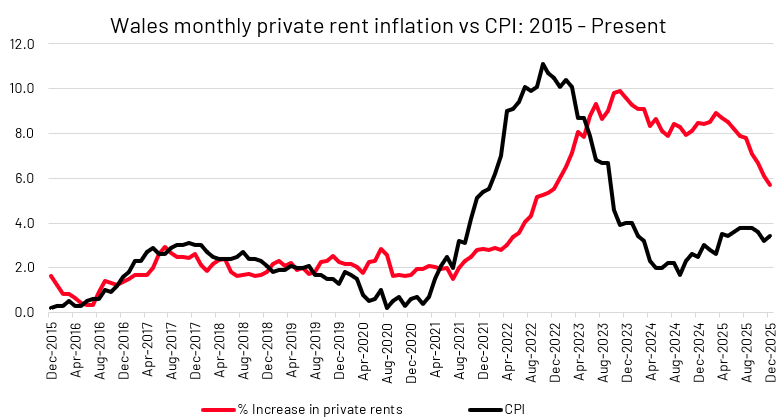
Ultimately, what all this data is telling us is something very simple and something we also know from the advice services that Shelter Cymru provides across Wales: older people are increasingly reliant on private renting and increasingly struggling because of that.
At Shelter Cymru we are currently calling on all political parties in Wales to make reforming the private rented sector so that it works for people a key part of their plans to end the housing emergency. And ensuring that the experiences of older renters are included in that is absolutely key, because ending the housing emergency means ending it for everyone.
And we are determined to play our part in this, which is why (with the support of the Oak Foundation) we have committed to a multi-year project that will empower private renters and ensure that their voice is heard by those with the power to effect change. To support this we have established an advisory group made up of private renters that will help us develop this project. We are committed to making that group representative of the private rented sector – ensuring no voice is lost and no experience or issue is missed.
If you are a private renter and would like to be involved in this work then please contact Elen, our private renting policy lead, and the team at Shelter Cymru: policyandresearch@sheltercymru.org.uk
[1] Data from Census 2021, omits Bridgend which is unavailable.