
Foreword
As the Older People’s Commissioner for Wales, I want to ensure that all older people in Wales have a voice, that the contribution older people make to our lives and society is recognised, and that the experiences of people from all backgrounds are used to improve policy and practice.
Understanding older people’s lived experiences in all of their diversity is therefore crucial to ensure support and services meet people’s needs, and resources are targeted appropriately.
Yet evidence and data relating to the lives of Black, Asian and Minority Ethnic older people is often very limited, meaning some people’s experiences are effectively being rendered invisible.
That is why I commissioned the research on which this report is based, which explored people’s lived experiences and covered a variety of issues – from access to services to the availability of social activities – working with organisations throughout Wales with strong community connections to Black, Asian and Minority Ethnic older people.
As demonstrated by the range of views and experiences expressed, Black, Asian and Minority Ethnic people in Wales are diverse, not a homogenous group, and the older people we spoke to had vastly different experiences and expectations depending on their age and circumstances.
This report provides a snapshot of these experiences, highlighting key issues and concerns, to help ensure that the voices of Black, Asian and Minority Ethnic older people are heard and listened to by policy- and decision-makers, complementing the vital work of community groups throughout Wales who do so much to give a voice to the people they work with and support.
I would like to thank all of the older people who took part in this research and my follow-up engagement, as well as the 13 organisations that undertook the interviews and have provided
ongoing support.
The information shared has provided important insights into the diversity of people’s lived experiences, as well as particular issues and barriers people are facing, and has helped to shape my own work as Commissioner.
For example, concerns raised about GP services and the impact of digital exclusion provided an even greater impetus to examine these issues in more detail and identify the action needed from public bodies to deliver crucial improvements.
I am also working with my team to make key information and resources more accessible for Black, Asian and Minority Ethnic older people, working with community groups to produce information leaflets in different languages, and sharing information through different formats such as video.
Heléna Herklots CBE
Older People’s Commissioner for Wales
Introduction
The lived experiences of Black, Asian and Minority Ethnic older people in Wales remain underexplored. The Covid-19 pandemic had a disproportionate impact on Black, Asian and Minority Ethnic people, including older people, and pre-existing inequalities have been exacerbated. Without a more specific focus, Black, Asian and Minority Ethnic older people and the issues affecting their lives are rendered invisible.
In response to this, the Commissioner sought to gather the lived experiences of Black, Asian and Minority Ethnic older people through working with the organisations and people with whom people engage regularly. The Commissioner used existing networks and methods of engagement to connect with older people (people aged 60+) and asked those organisations and individuals that facilitate such engagement to gather the personal accounts or the lived experiences of what it is like for Black, Asian and Minority Ethnic people to grow older in Wales.
Older people who took part were able to determine what they wanted to share as part of their ‘lived experience’, and this report was written based on these findings.
Prior to publication, the Commissioner and her team arranged follow up engagement events with the organisations and older people who had taken part, in the format which best suited the
groups. Some of these took place as face-to-face events, whilst other organisations received a video, or written feedback from the Commissioner.
These follow ups allowed the older people and organisations who enabled the research to hear the Commissioner’s findings and discuss how the report captured their views and experiences.
During face-to-face follow ups, older people were interested in what the research had found, and the action that the Commissioner has taken as a result, which, as highlighted, below
includes work focused on digital exclusion and access to GP practices, both key issues raised as part of this research.
Demographics in Wales
There is little ethnic diversity in the older population in Wales, with 97.8% of older people identifying as White British, although projections indicate this will change over time: 98.8% of over 75s identify as White British, compared with 97.2% of 60-74-year-olds and 94.6% of 16- 64s. This indicates that there are around 19,000 Black, Asian, and Minority Ethnic older people living in Wales, 3,700 over 75s, and 15,700 60-74 year olds.
The full ethnic breakdown of Wales is difficult to estimate because older people, especially those who identify as being from an ethnic minority, have often been under-represented in population surveys. However, it is positive that the new Census data includes age and ethnicity breakdowns.
According to this data1, the proportion of Black, Asian and Minority Ethnic people is highest in urban areas of Wales – in Cardiff, Newport and Swansea in particular – and lowest in rural
areas and some parts of the south Wales valleys. The number of older Black, Asian, and Minority Ethnic people living in Wales ranged from 148 in Blaenau Gwent and 178 in Anglesey, to 5,344 in Cardiff and 1,477 in Newport.
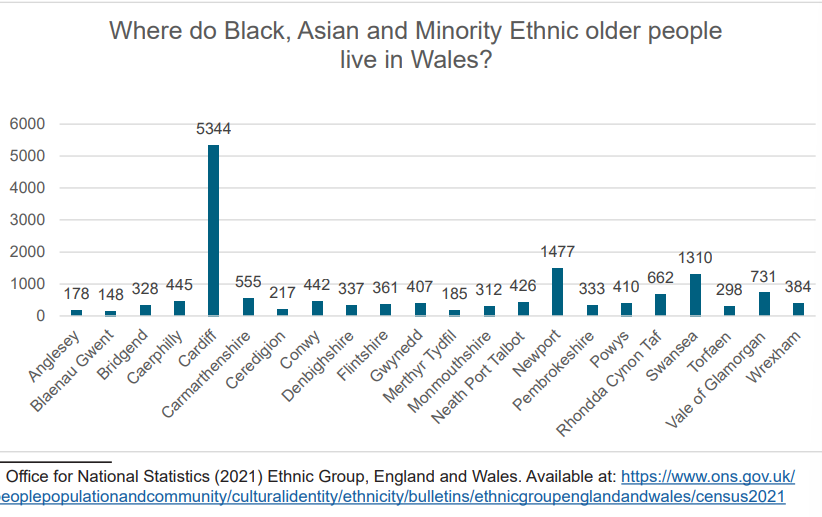
The lack of detailed data highlights the importance of engagement and research with Black, Asian, and Minority Ethnic older people to provide a greater insight into people’s lived
experiences and a better understanding of the diversity within these communities.
In the future, the Welsh Government’s Anti-Racist Wales Action Plan will implement new surveys and change sampling strategies to ensure adequate participation of ethnic minority participants. The Welsh Government has also agreed to invest in and set up an Equality Data Unit to improve data on seldom-heard groups in Wales, both of which represent important steps forward in improving the data available about the experiences of Black, Asian and Minority Ethnic people.
Methodology
The Commissioner wanted to build on engagement with organisations representing Black, Asian and Minority Ethnic older people and determined that a programme of targeted engagement, working with local community groups, would be an effective way of reaching out to hear about their experiences of growing older.
To support this work and provide expert advice and guidance to maximise its impact, the Commissioner established an Advisory Group made up of representatives of Black, Asian and Minority Ethnic organisations and other key stakeholders. The Advisory Group supported and shaped the methodology and development of the targeted engagement.
In summer 2022, the Commissioner announced she was seeking established individuals/organisations that have strong community connections with Black, Asian and Minority Ethnic
older people to facilitate engagement sessions to gather information about people’s lived experiences. Information about how to apply for small amounts of funding to support this were
shared with stakeholders and via social media, and a total of 13 organisations were funded to undertake a series of in-depth, semi-structured qualitative interviews throughout Wales to hear
from older people. Details of these organisations can be found in Appendix 1.
The Commissioner provided a set of interview questions to provide a framework around which interviews could be structured. These covered a range of topics, including people’s experiences during the pandemic, as well as issues relating to the Commissioner’s four priorities – rights, ageism, abuse and ageing well:
1. What is life like for you being an older person in Wales?
2. Do you feel that you have ever been treated differently because of your age?
3. Are there things that you would like to change to make your life better?
4. How would you access information or help if you needed advice or support?
5. What is your experience of using public services such as GPs, hospitals, social services?
6. What is the best thing about being over 60?
During autumn 2022, interviews were undertaken through a variety of formats, including one-to-one and group-based engagement sessions. Translation was provided to ensure that older people were able to contribute using their language of choice (many individuals were not confident communicating in English as it was not their first language).
A thematic analysis of the responses was subsequently undertaken to identify the key issues on which this report is focused.
Participant Demographics
A total of 263 older people took part in interviews to share their lived experiences, with demographic information provided for 187 people. Of these 187:
• 64% were female, 36% were male
• 66 people were aged 55-65, 24 were aged 66-70, 23 were aged 71-75 and 19 were aged 75+
• 32% identified as Black
• 43% identified as Asian
We received responses from older people living throughout Wales, providing us with information and data from a wide range of areas, including urban and rural areas.
The organisations that supported our engagement sessions were based throughout Wales and were able to reach out to and hear from Black, Asian and Minority Ethnic older people from a wide variety of backgrounds. The organisations who supported the work were:
• Black, Asian and Minority Ethnic Mental Health Support (BMHS)
• EYST (Ethnic Minorities & Youth Support Team)
• The India Centre
• Caribbean Heritage Cymru
• Newport City Council
• Women Connect First / Mela Cymru
• Women’s Advocacy Network (WAN)
• North East Wales Community Cohesion Wrexham CBC
• Zimbabwe Newport Volunteering Association
• South Riverside Community Development Centre
• North Wales Regional Equality Network (NWREN)
• Race Council Cymru – Windrush Elders
• Gypsies and Travellers Wales
As noted above, 187 out of 263 people provided demographic information, including age, sex, and ethnic group, but people were also able to remain anonymous and to provide their experiences confidentially if they wished, which was important to some people, especially those who were refugees and asylum seekers.
The quotes used throughout this report are from individuals who had attended meetings with, or were members of, the groups conducting this research. However, older people shared information about their experiences as individuals, rather than as members of any particular ethnic, community, or social group, and it is important to emphasise the individuality of the people whose voices are at the heart of this report.
Black, Asian and Minority Ethnic older people are not a homogenous group, nor are members of each organisation, and the responses analysed for this report emphasise this. For these
reasons, we have not included any identifying information in the quotes or attributed them to any individual or group.
Key themes
Many positive experiences were shared, covering a wide range of topics. The majority of Black, Asian and Minority Ethnic older people told us Wales is a ‘lovely’ place to grow older, and particularly valued free healthcare, the ability to be independent, and being able to travel for free using their bus pass. A number of older people enjoyed being able to work, whilst others enjoyed a comfortable retirement. Some were also pleased with the opportunities they had to pursue activities that were important to them.
Older people said they felt at home in Wales, and many were content and happy. Some felt encouraged to be independent, and that they had the resources and support needed to be able to do this. There was also a consensus that Wales was a safe place to grow older, which many older people valued. Others liked Wales as a country, describing it as beautiful and peaceful, and therefore a nice place to live. There was a general feeling that people in Wales are friendly and welcoming, and that Wales is multicultural with lots of interesting people and communities.
Alongside these positive experiences of growing older, however, Black, Asian and Minority Ethnic older people also described a number of issues and barriers that affect their lives and impact upon the ways they engage with services, support and their communities:
Language: Barriers and difficulties relating to language and communication affected older people in a variety of circumstances, including when accessing services and information, using public transport, and connecting with social groups. This led to frustration and anxiety in many aspects of older people’s lives.
Access to services: Older people often found services difficult to access, particularly health services, which was exacerbated by the Covid-19 pandemic. Key issues experienced included long delays accessing appointments, difficulties booking appointments at convenient times, and barriers due to a lack of translation services.
Discrimination: Older people said their age and ethnicity were both factors that contributed to them being treated differently. Older people also reported facing discrimination when accessing
services from professionals, people from other age groups and even by people within their own communities.
Feelings of exclusion: Older people shared a number of issues and barriers that made them feel excluded from society – including language barriers, a lack of support and services, and
being digitally excluded – which meant a majority often had to rely on family members, friends, local faith groups and charities as key sources of support, information and guidance.
Concerns about the future: Many older people shared concerns about what the future might hold for them and their loved ones, with particular concerns about the impact of poor health and financial pressures.
Language
The ability to speak English varied widely amongst Black, Asian and Minority Ethnic older people, and English was not the first language for many. Some were able to speak and read English fluently, while others were unable to use it at all.
The majority of older people discussed language within their responses, highlighting that language barriers impacted upon many aspects of their lives. Language barriers created misunderstandings that often left people feeling frustrated and anxious due to not being able to get their point across clearly.
“I struggle with English and that is my biggest worry. To bring in money and trying to learn the language … sometimes I get very confused, especially in a stressful situation or when the language is formal.”
“My English is limited, I also have hearing loss. This makes it very challenging for me to communicate and access the right information.”
Alongside highlighting the general difficulties faced due to language barriers, older people also discussed the specific ways this impacted upon their lives, such as not being able to make
appointments, go shopping or use the correct money. Many also highlighted that support through translators is very limited, despite their importance in helping older people to overcome
language barriers.
Many Black, Asian and Minority Ethnic older people therefore relied a great deal on family members and friends for support to access information and services.
“I have a very good support network. My daughter, sister, nieces, nephews, and all help.”
“I am reliant on family and friends because of language barriers.”
“Hard, without the support of my family as my English isn’t very good.”
In some cases, older people said that language barriers meant they would find it impossible to access information and services without support.
“I cannot access support as I don’t speak English very well, but my daughters will access a lot for me.”
“I would ask my children to help or not get any advice or support.”
Of great concern is the fact that some older people described feeling that they received poorer services due to being unable to speak English, highlighting their own experiences, as well as
those of their family and friends.
“Sometimes women can’t speak the language and they don’t have an interpreter. They don’t call back until three days later. If it’s urgent, you are just left.”
“Usually, I don’t feel that I am treated differently because of my age. However, at the GP surgery I feel a little discrimination because of my language. Once they didn’t support me even though I was suffering, they just asked me to leave.”
“I have faced unequal treatment many times for many reasons. This can be because I can’t understand English well and am no good in responding if I get ill-treated, I can’t stand or speak to challenge others.”
“Most of my friends have backed off because of the health issues and language problem. The behaviour of other people has affected my confidence – I feel I am not taken seriously.”
Other comments highlighted that many older people felt invisible and unheard due to language barriers, and felt that professionals were not interested in what they had to say or what they were experiencing, which adversely affected their confidence and undermined their faith in public services.
In addition, older people said they often felt unable to voice their concerns or challenge poor services, leaving them feeling frustrated and unable to resolve issues they were facing.
Health and well-being
The importance of good health and well-being was a key issue for many Black, Asian and Minority Ethnic older people, who recognised the role this can play in peoples experiences of
growing older. Indeed, some explicitly equated good health with happiness and a good life.
“My life in Wales is good. I’m relatively healthy with a good network of family and friends and social activities I enjoy.”
“Life is happy for me, nothing worrying me at the moment, health is good at the moment.”
“I have a good life. If we are healthy and keep ourselves busy, we can be happy. Therefore, I’m happy.”
“Being here still healthy and ok. I know some people my age are not doing ok. I’m lucky.”
“I am in good health and have a nice home. I am happy.”
These older people often said they felt ‘lucky’ to be in good health, indicating that they understood that other older people were less fortunate, and what this meant in terms of their experiences.
This was reflected in comments from other older people, who shared the negative impact that health problems had on their lives, especially during the winter months. For some, ill-health had a major impact on their day-to-day lives, while others experienced issues such as increased pain, which was also associated with a loss of mobility. Some older people also highlighted increased worry and anxiety as they got older, suggesting they were struggling with aspects of
their mental health.
Issues like these meant that some older people spend most or all of their time at home due to poor health – whether through choice, lack of motivation, or necessity – leaving them feeling
restricted and unable to do the things that matter to them, often in contrast to when they were younger.
Some older people were also concerned about what health problems might mean for them in the longer term, sharing concerns and fears about how they would cope or look after
themselves in the future, particularly if their health deteriorated further.
“I even get scared to get ill thinking how will l be able to look after myself if l become unwell?”
“It has become difficult to go through life every day because of mobility problems and other underlying health issues.”
Access to health services
For some Black, Asian and Minority Ethnic older people, accessing health services in Wales was a positive, straightforward experience. They were happy with the treatment and services
offered and received and were grateful for the NHS.
“I find that the service is good, and everyone looks after me nicely.”
“Good GP experience. I feel listened to when I go.”
“Public services are good and provide a lot of support, but I need my family to be there with me. GP and hospital appointments have been good. They understand my needs and support me accordingly.”
Many of these older people felt confident and independent enough to visit GPs and hospitals by themselves, and praised doctors, nurses, receptionists, surgeons and dentists for their
behaviour, professional conduct, and ability to provide a good service, even in times of great strain, such as during the Covid-19 pandemic.
Those with positive experiences said they felt listened to and that their needs had been taken into account, providing a more ‘personal’ service. For some, this meant timely, face-to-face
appointments, while others valued being able to seek reassurance over the phone.
However, far more older people reported negative experiences and highlighted the difficulties they had faced when trying to access health services, something that seemed to be a very
frustrating and demoralising experience.
“It seems like I keep getting doors closed when I need a service. This makes me feel discouraged and give up when I am not heard.”
“I feel like I am slowly fading into the background especially as I don’t get heard.”
Common issues experienced by older people included difficulties contacting GP surgeries by telephone to seek advice or make appointments – phone lines were often engaged or not answered, or people were cut off – as well as long waiting times for appointments (up to three weeks in some cases) and treatment. Some older people also highlighted the impact of the pandemic, and reported similar issues when trying to access hospital services and dentists.
“My experience with the GP has been awful as I can call 20 times and still receive no answer. Before the pandemic it wasn’t too bad but since the pandemic you can’t really speak to any of the doctors.”
“One thing disturbs me – the health service after Covid. Almost all people my age need the health service more than other age groups. Since Covid I’ve started to think that it would be worth getting health insurance. Whenever I need to see the GP, I ring in the morning at 8am. The ringing carries on, and nobody is available to attend the call. After two hours, the receptionist says, ‘We were busy’.”
“Waiting lists are so long for the NHS or hospital.”
“Dentist is a nightmare, it’s hard to get onto a dentist list and one can easily be removed for not going for an appointment in 18 months.”
Some older people shared that they were discouraged from trying to access health services at all as they felt they would not be able to access what they needed, while in a couple of cases older people said they had contemplated seeking treatment abroad due to waiting times.
When older people did manage to access health services, they faced further issues and barriers, highlighting that they found it difficult to ‘navigate the system’ and that healthcare environments were often busy, with lots of patients and queues, leaving people feeling overwhelmed and stressed. As highlighted in the section above, language barriers also often created difficulties for older people when using health services, and some shared that they felt like ‘staff did not want to deal with them’ when they sought information or help.
Perhaps the most concerning issue faced by some older people was feeling discriminated when using health services due to their ethnicity.
Support for Black, Asian and Minority Ethnic older people within the health system, such as translation services, was often said to be very limited, which left people unable to make their voices heard like other patients and could lead to staff becoming impatient.
Older people also shared examples of being spoken to in a patronising way, or even shouted at, which left people feeling worthless.
Shockingly, it was also suggested by some that diagnoses were being made on the basis of an individual’s skin colour, rather than properly assessing their health or symptoms.
In addition to these examples, some older people also highlighted how they felt discriminated by health services due to their age.
“I feel like they fob me off and put everything down to my age. Yes, especially when I seek medical treatment. They care less when you’re older. I try my best to stand up for myself.”
“I do feel as you get older you are treated with less care by medical services.”
“There was an incident at my GP surgery when I turned up for the appointment, was not seen for more than an hour, when requested information, was told that ‘I called but you didn’t show up and now you need to book another appointment’. As if this waste of time wasn’t enough, they sent out a letter stating that you didn’t come for the appointment, and we will strike you off our list. That was very bad experience for an 81-year-old lady.”
Many older people spoke about improving their own personal health, and the benefits this could bring as they got older, highlighting that improving access to health services was a key part of this. These older people said they would benefit from face-to-face appointments and regular check-ups, with support to overcome language barriers, as well as culturally-specific services, and additional support for Black, Asian and Minority Ethnic older people living with dementia.
These findings influenced the decision of the Commissioner to undertake further research into accessing primary care services and older people’s experiences of this.
Wider discrimination
Black, Asian and Minority Ethnic older people highlighted that discrimination is not confined to health services, and that they had also been treated differently because of their ethnicity and/or age when accessing services, in the workplace and in the community.
“I think I get treated differently because of my colour and age.”
“Of course [I have experienced discrimination], but I think it has more to do with me being an older Black man. Wales has not progressed since the African/Afro Caribbeans, Yemenis and Asian immigrants arrived in the 1890s. It’s 2022 and there is still a lack of representation of our community in our local authority and local government.”
“Things you want to do or places you want to go may not be accessible because of your age.”
“Yes, because of my ethnicity I have experienced a lot of discrimination when trying to access services the lack of an interpreter made me feel I have been treated differently. Also, I have experienced a lot of racial abuse in the community, and this has made me be afraid to access some services. I have also experienced being treated differently in my workplace for example promotions are not given to people from minority ethnic groups.”
Some older people also highlighted the ways that discrimination can impact on employment opportunities, particularly in more manual or task-based roles.
“The lower down you are, the more manual your position, you won’t be able to reduce your hours or transfer roles.”
“Employers always consider whether I can do the job same as younger person, will I be slower in labour work?”
Alongside feeling worried about being unable to access the services and opportunities they needed, some older people said that discrimination also manifested itself in the way they were
treated in their day-to-day lives. They described feeling dismissed and that their views didn’t matter, as well as being shown a lack of respect by both the public and professionals.
“I don’t feel listened to… confidence can be an issue; it depends on the situation… I feel I have less authority, are people listening to me?”
“I feel this all the time as I don’t feel that people care about us older people. They are not interested in what we have to say or what we feel. This is across the board – housing, health, transport, just everything that affects us. Whatever we may say, it just feels that people don’t care what we may have to say, so feel
almost invisible. We should have the right to express what we feel regardless of our age etc. I feel dismissed a lot of the time.”
“Sometime confidence can go down; people are not kind…they can have a dismissive attitude… they can be obstructive.”
“I feel that I have been treated differently due to my ethnicity and age so two reasons. People don’t recognise us as important people. I feel that people think because of our age, we don’t matter and that we don’t know anything. Also, as English is my second language, I really don’t matter to them.”
On a more positive note, many older people said they believed they had never been discriminated against as they grew older, citing several reasons as to why this might have been the case, including looking younger, being fit and healthy, being active in the community and because Wales is an inclusive country filled with kind, warm people.
“No, I have never been a victim of age discrimination whatsoever. I have always been active in the community and participating in group activities either in my church life or socially. I believe that’s because people don’t realise how old I am!”
“I feel I am treated more respectfully because of my age as I participate with people from all walks of life regardless of age colour creed and religious backgrounds.”
“I have always been treated fairly, with warmth and friendly manner by the public when I am out and about.”
These older people – who were active members of the community and often interacted with like-minded people – felt that their personality and confidence had contributed to their acceptance and decreased the chances of suffering hostility. They also felt that they were treated the same as they always had been, with no difference as they got older apart from, in some cases, people being even warmer and kinder than previously.
However, some responses suggested that ageism may not have been recognised or had been internalised by older people. In some situations, even where individuals did not feel as though they had experienced ageism, they subsequently spoke about feeling too old to receive adequate health services, or that seeking employment had been more difficult due to their age.
Loneliness and social isolation
Some Black, Asian and Minority Ethnic older people shared positive experiences of living in their community, saying they felt well-known and respected, due to their skills and life experience.
“It’s good and positive and older people in ethnic minority communities are valued and respected by communities and extended family.”
However, feelings of loneliness and social isolation were common amongst many older people, particularly where an individual had experienced a bereavement. People reported feeling invisible, like they had been ‘forgotten about’, and associated loneliness with a lack of support.
“Since becoming a widow its different, lost my confidence, and feel lonely.”
“If you’re on your own its very lonely, I feel isolated most days, and it’s a long day to go through on your own. I am a widow.”
“I feel very lonely. I don’t like to cook and eat alone. I feel really sad. I was more active when the family were around. For one person there isn’t much housework.”
Some older people also suggested that changing dynamics within communities could be impacting upon loneliness.
“It’s very lonely, even when you have children but everyone has fled the nest. I thought it would be like the olden days when there were communities and everyone mixed together.”
“Yes, there is a lack of community… families live further away.”
“I am lonely, I eat alone, now I can’t be bothered to cook or eat even though I have adult children who live in Cardiff, they have busy lives.”
Other responses highlighted additional issues that exacerbate loneliness and isolation, which included a loss of routine following retirement or children moving out, health problems or limited mobility meaning people were unable to get out and about or travel to see family or friends, difficulties accessing transport, and a lack of families from similar backgrounds living locally.
The crucial role of social groups and activities in helping to tackle loneliness was discussed, although several older people said that these kinds of activities were often limited and that they often struggled to find information about what was available in their area.
“Sometimes I am not just alone but lonely. If there were activities and I could afford and get to them, I would go.”
“Not being able to go out, very isolating and this experience of loneliness as there is no support group in my area.”
“If there was only a place you know, people would have company or distract themselves once or twice a week or anything. I think there’s a big gap in this in the community at the moment.”
Older people who had taken part in social activities said they had helped them to form new connections and friendships, highlighting the positive difference these can make when people
are feeling lonely, and why opportunities to take part in such activities are important. Similarly, some older people said they had made the decision to volunteer or go back to work and found this to be a very positive experience, again indicating the importance of these kinds of opportunities to support older people who may be experiencing loneliness to make new
connections.
Finances and cost of living
A number of Black, Asian and Minority Ethnic older people discussed the impact of the cost-of-living crisis and shared concerns about their finances. In many cases, people felt that their incomes were reducing as they got older, leaving them facing increasing financial pressures.
Some older people described struggling with food and energy costs, saying that support with these would help to improve their lives. In addition, several said that a lack of available funds left
them unable to get out and about and do the things that matter to them as they could not afford the costs of social activities or travel, leaving them feeling excluded.
“As we have got older our income has reduced …there is not enough money, the pension is not enough. When your income reduces its hard its stressful.”
“I try to shop for reduced items.”
“The Cost of living is a problem…. It is difficult to afford basic things at the moment …. I eat less fruit and veg now.”
Even the older people who were currently financially secure said they had some concerns about how potential money problems might affect them in the future.
Part of the discussions on finances focused on employment and alongside sharing examples of discrimination they had faced when working or seeking employment (as highlighted above),
some older people also highlighted their experiences of other employment-related barriers.
“It has become harder as one has to continue working to the age of 67 years. Not everyone above 60 is blessed with good health to continue working to that age. When the economy is not performing the seniors are affected more. Pensions and savings are eroded by the cost of living. The energy bills are just going to
compound the problem further.”
“I think if it was possible to sort of reinvent jobs or work for people over 60 then we could focus on applying for these jobs and feel like you have a chance because they are jobs for us.”
Older people discussed whether there were ‘appropriate’ jobs for older people, and some individuals who were looking for work shared that they were worried that employers would think they would be ‘too old’ or unable to cope, particularly with manual roles. In addition, some concerns were raised that older workers may not be offered opportunities for training or promotions due to their age.
Ultimately, choice was an important factor: older people wanted to be able to work if they wished to, but also to have the option to retire if that was the right choice for them.
Some concerns were also raised about the risks of financial abuse in the form of fraud or scams. Several also felt they were particularly vulnerable as older people.
“There is a lot of fraud and scammers …. You get lots of phone calls.”
“We need more education – scammers target older people online. We feel left behind we’re not educated in IT; I would like to learn but I need to write things down, we want digital courses but the right ones.”
“We are vulnerable, it feels embarrassing.”
“I have a lot of fraud and scams and I’m constantly being approached and its stressful not knowing who is genuine or not.”
Older people shared that being a potential target made them feel afraid, vulnerable and anxious, as well as uneducated and embarrassed.
Transport
Many Black, Asian and Minority Ethnic older people were unable to drive, or chose not to, and for many of these individuals, public transport was seen as a crucial alternative that enabled
them to maintain their independence. Furthermore, some older people who struggled with ill-health or mobility issues, saw public transport as a ‘lifeline’ to get them out into the community.
However, many people had also experienced issues when using public transport, which included problems with accessibility (something highlighted by older people who had lived in large cities in particular), limited and unreliable services, and difficulties finding information about changes to services / timetables. Some older people added that using public transport to do things like go shopping or attend social activities was becoming increasingly difficult, leaving them feeling more and more isolated, and there was strong agreement that improvements were needed to encourage and enable people to use public transport.
“Public transport is not reliable and is less frequent in the evenings.”
“Going out is hard, bus routes are difficult.”
“Transport links to wider UK destinations are quite good, however local links for shop etc. are not great.”
“I have a free bus pass, but on the other hand buses are never on time.”
Accessing public transport was even more difficult for older people living in rural areas, and community transport options were often very limited. These individuals said that improved, more regular, transport options that enabled travel ‘into town’ would allow them to get out and about and socialise more. This view was reflected by others, who said they were sometimes unable to attend social activities in their communities due to a lack of transport options.
In addition, older people said they had faced particular difficulties accessing GP surgeries or hospital appointments using public transport, with some saying they had missed appointments due to its unreliability.
“Better transport arrangements for hospital appointment because sometimes appointments are offered very early and in other cities. Everyone doesn’t have cars or families to drive us.”
For those who used public transport, the concessionary bus pass was of ‘enormous benefit’, with some saying it was the best thing about being over 60 and living in Wales. Many older people relied on public transport more than when they were younger, and the pass enabled them to do a range of things, such as visiting family and friends, taking part in social activities
and, in some cases, going to work.
“I appreciate the way they look after me in terms of giving me free bus pass.”
“Free travel bus pass is the best thing.”
“I have a bus pass to move around Wales if I want to get out, or even to go to work. That is an expense, especially when the money is less- it goes a long way.”
“Life is harder, getting out and about is hard. Mobility issues make life harder. We have a free bus pass which helps me to get out sometimes.”
Some older people said that bus passes should be issued automatically when a person turns 60, so that they would not have to apply, to ensure that everyone who is eligible would receive one. Older people also highlighted the difficulties that asylum seekers and/or refugees aged 60+ can face when trying to access the concessionary bus pass, which requires certain types
of supporting documents and identification. For some people, this meant being unable to apply for a pass and, subsequently, being unable to use public transport as they could not afford the
costs, something that leaves older people at particular risk of becoming lonely and isolated.
Caring and care
While discussions about caring responsibilities and care were relatively limited, some Black, Asian and Minority Ethnic older people highlighted their role as a carer or shared their experiences of being cared for.
In some cases, older people spoke about having to provide care for their partners or other family members, as they did not want to receive care from paid carers. Others highlighted that they had struggled to find carers that could meet their cultural or language needs, or that they had experienced poor care in the past.
“They said they would start physio and scans we’re still waiting. He rarely walks, so I have to help him dress… I’m not well myself but he doesn’t want carers.”
“I speak Bengali and I have been looking for a male carer for four years, but I haven’t found one within our community. I need some Bengali-speaking male carers. I wish I had someone to look after me and to always be beside me when my family is away at work. If I had a Bengali companion, then I would feel more
confident and maybe have the courage to go out more.”
“With social services we had female carers for my husband when he was unwell, who helped clean him, for cultural reasons my husband felt uncomfortable with a female carer, and I ended up helping him with personal care.”
For some older people, providing care was a rewarding experience, and examples were shared of feeling ‘at a loss’ when caring responsibilities ended. Others, however, found providing care to loved ones more difficult.
“We feel stuck at home and can’t go out much. I constantly need to care for my husband, and I don’t get much time for myself.”
These older people said that the caring role could be overwhelming, and impacted on every aspect of their lives. One person also shared that they had needed to give up their full-time job in order to care for their partner, an issue that affects many unpaid carers.
Digital inclusion
Many Black, Asian and Minority Ethnic older people had embraced digital technology and were digitally confident, increasingly using the internet to access information and services.
“I would go online and search for the relevant information I need.”
“Google, as I have worked all my life, and have good digital skills.”
However, other older people said they found technology ‘daunting’ meaning they felt unable to engage digitally or had limited digital skills.
“Digitally I wouldn’t have a clue or on the phone, I would ask a family member.”
“Sorry… my son goes online…Only cell phone and Google only. I don’t operate these things… but not thoroughly a computer, no I don’t use.”
“Life was simpler without all the technology we could get by. But now with IT systems, it’s much harder to navigate and work everything out …it’s difficult.”
This impacted on older people’s lives in a number of ways, often leaving them feeling excluded, left behind and isolated, particularly when they were unable to connect with family and friends (a particular issue during the pandemic). In addition, some older people said they felt embarrassed about their lack of digital skills, particularly as assumptions are often made that everyone has the skills to access information and services online, and that the shift towards digital was a source of stress and anxiety.
“…we feel left behind we’re not educated in IT, would like to learn but I need to write things down, digital courses but the right ones.”
“We need digital support … I feel like an idiot.”
“Technology is so advanced, and they presume you can use everything but it’s really hard to work it out. It makes me feel sad and embarrassed.”
“Everything is online now it’s very stressful.”
Specific support and activities for Black, Asian and
Minority Ethnic people
Many Black, Asian and Minority Ethnic older people spoke about the importance of social interaction, and the crucial role of organised activities, to provide stimulation, learning opportunities, physical well-being activities, social contact and a sense of community. The most popular activities were those which overcame linguistic barriers and allowed for inclusion.
Some older people shared that being involved with groups and clubs gave meaning to their lives, and they enjoyed having a regular routine where they could interact with family, friends
and local communities. Others said that these kinds of activities were the best thing about being over 60.
Older people said they wanted to see more activities aimed specifically at Black, Asian and Minority Ethnic people – such as opportunities for adult learning and learning languages (with
lower fees), social / befriending clubs, as well as activities such as dancing, exercise classes, tennis, bowling and chess – which would help to improve their lives.
However, many older people said that they struggled to access these kinds of activities where they lived.
“It would be good to get some more clubs for ethnic minorities, like a keep fit class for over 60 women, outings and trips.”
“I live far away from local diverse communities with no ethnic minority groups in my area. There are groups but far away from my house and no transport or help to get there and back.”
“Yes, get more involved in charity projects and gatherings were there are groups of friends from different culture, etc. More needs to be done in education and for mixing more – sometimes other British communities think that we from different communities, we don’t mix, changes should be made to this.”
“Local council or community organisation ensure provide more age friendly activities or craft workshop to keep us mentally healthy.”
A number of older people said that they found it difficult to find information about activities in their area and said there was a need for better promotion, specific information aimed at Black,
Asian and Minority Ethnic older people, and better representation of Black, Asian and Minority Ethnic older people in their communities within communications materials.
“I find there is not so many services for older BAME in Newport where I live. No specialist lunch clubs etc… I find ethnicity data/information is very poor.”
“First of all, better information about the services and facilities available. Colourful and artistic leaflets, even in different languages, don’t always work for everyone. Many of us ‘seniors may need not only translation but explanation too.”
“Yes, people should have more information from the council and other organisations so they can take advantage of grants and funding, and they don’t know how to find information.”
Positive experiences of being over 60, and what could
be improved
While Black, Asian and Minority Ethnic older people did highlight issues and challenges they face in many aspects of their lives as explored above, it is also important to note that for many,
growing older was a positive experience, which they said made them happy to live in Wales.
“I have lived in Wales most of my adult life, from when I got married here in Newport in 1985, had our two children and raised them here, I can honestly say this has been home for me.”
“I am quite happy that I’m growing old in Wales, especially because here everyone encourages older people to be independent, which I like. I compare myself with older people back in my home country, and I think they look older than their age because they are completely dependent on others.”
“Being an old age person and living in Wales feels fantastic. Because Wales is very beautiful and peaceful place to live.”
Some older people felt that there was nothing that could be improved about their lives, and that their experiences of growing older had been positive. A number of reasons were shared for this, including reduced stress, a greater sense of freedom, and more free time.
“We are happy as our family lives here so we wouldn’t change anything as it’s the best.”
“It feels like my time now. I can do what I like.”
“I like the freedom it offers.”
“Your own time, stress free, life is good, life begins.”
Spending time with family, particularly grandchildren, was also highlighted by many older people as being one of the best things about growing older.
“The freedom to enjoy time with grandchildren.”
“It is nice to be available to help out with my grandkids.”
“All I have to do is spoil grandchildren.”
Having more time and fewer responsibilities – as a result of retirement or working fewer hours, or no longer needing to ‘run a household’ – also enabled some older people to pursue new
interests or return to old hobbies.
“I think best thing being over 60 is I am my own boss. No early morning rushes, no more stuck in traffic jams in the mornings, no mortgage to pay. I can sit back and see youngsters making mistakes or successes. Give advice when asked for. I have more time for my friends and neighbours. More time to learn new crafts. There is no ME or MY in my vocabulary anymore.”
“In the local community centre, there was a group where we had different activities such as going out for a walk, cooking classes, arts, and crafts and many more activities. We had a lot of a support in all languages to help solve problems for everyone.”
Supporting and shaping the Commissioner’s work
The experiences shared by Black, Asian and Minority Ethnic older people, and the particular difficulties highlighted, have supported the Commissioner’s work to influence a wide range of
policy and practice, by providing crucial evidence that demonstrates the diversity within the older population in Wales.
In addition, the Commissioner’s work with Black, Asian and Minority Ethnic older people was also important in the development of two key pieces of work relating to digital exclusion and access to primary healthcare services.
During autumn 2023, the Commissioner invited older people throughout Wales to share their experiences of digital exclusion and the impact this has on their lives, as well as any examples
of good practice. To reach out as widely as possible to older people, the Commissioner shared information about this work and her survey with the groups who supported this research, so they could distribute this to Black, Asian and Minority Ethnic older people and encourage people to have their say.
The experiences shared with the Commissioner formed the basis for her Access Denied’ report, published in January 2024, which highlights that Black, Asian and Minority Ethnic older people
often face additional barriers relating to language and accessibility, and called for further action to tackle these kinds of issues.
The experiences of Black, Asian and Minority Ethnic older people also formed a key part of the Commissioner’s report on older people’s access to GP practices, published in March 2024. The report includes quotes shared as part of this research and includes a specific section exploring the particular issues that Black, Asian and Minority Ethnic older people may experience, as well as specific recommendations to tackle these.
These pieces of work will go some way towards addressing the challenges set out in this report, but the Commissioner also wants to see further action to ensure that in Wales, older people in all of their diversity are valued, rights are upheld, and everyone is able to age well.
Conclusion
This work was commissioned to help give a voice to Black, Asian and Minority Ethnic older people and it provides a snapshot of people’s lived experiences of growing older in Wales. It is positive that many older people reported good experiences, and highly valued things like free healthcare and the concessionary bus pass, which supported them to be independent, as well as opportunities they have to pursue activities that are important to them.
However, older people also described a number of issues and barriers that affect their lives and impact upon the ways they engage with services, support and their communities, including
language barriers, discrimination, feelings of exclusion, and concerns about the future. For example, as highlighted above, particular issues relating to digital exclusion left older people
feeling left behind, and anxious, while accessing GP services was also often difficult.
Just as Black, Asian and Minority Ethnic older people are not a homogenous group, Wales is not a homogenous place, and where people lived played a part in shaping their experiences. This demonstrates the importance of local solutions and action as part of tackling the challenges faced by Black, Asian and Minority Ethnic older people in different parts of Wales.
There needs to be space and opportunity for Black, Asian and Minority Ethnic older people to do the things that are important to them, whatever those things may be, and the experiences
shared highlight the importance of specific support and activities to enable Black, Asian and Minority Ethnic older people to age well and continue to enjoy living in Wales.
As the demographics in Wales continue to change, it is crucial that more data and evidence is gathered about the lived experiences of Black, Asian and Minority Ethnic older people in Wales so that policy- and decision-makers understand the things that make a positive difference to people’s lives, as well as where resources are needed to tackle specific issues and challenges to ensure that no-one is left behind.
Thanks and Acknowledgements
The Commissioner would like to thank all of the Black, Asian and Minority Ethnic older people who contributed to this report by sharing their experiences so openly to provide a picture of the
lived experiences of being a Black, Asian and Minority Ethnic older person in Wales. Thanks also to all of the organisations and groups that worked with the Commissioner to reach out to older people and facilitate sessions to capture their experiences, as well as to members of the Advisory Group for their insight and support.
Appendix 1
Organisations who supported this research:
• Black, Asian and Minority Ethnic Mental Health Support (BMHS)
• EYST (Ethnic Minorities & Youth Support Team)
• The India Centre
• Caribbean Heritage Cymru
• Newport City Council
• Women Connect First / Mela Cymru
• Women’s Advocacy Network (WAN)
• North East Wales Community Cohesion Wrexham CBC
• Zimbabwe Newport Volunteering Association
• South Riverside Community Development Centre
• North Wales Regional Equality Network (NWREN)
• Race Council Cymru – Windrush Elders
• Gypsies and Travellers Wales